
Conversations That Move the Industry Forward.
Industry data, professional perspectives, emerging concerns, and honest conversations about what’s happening in esthetics—and where the industry goes from here.
Latest Insights
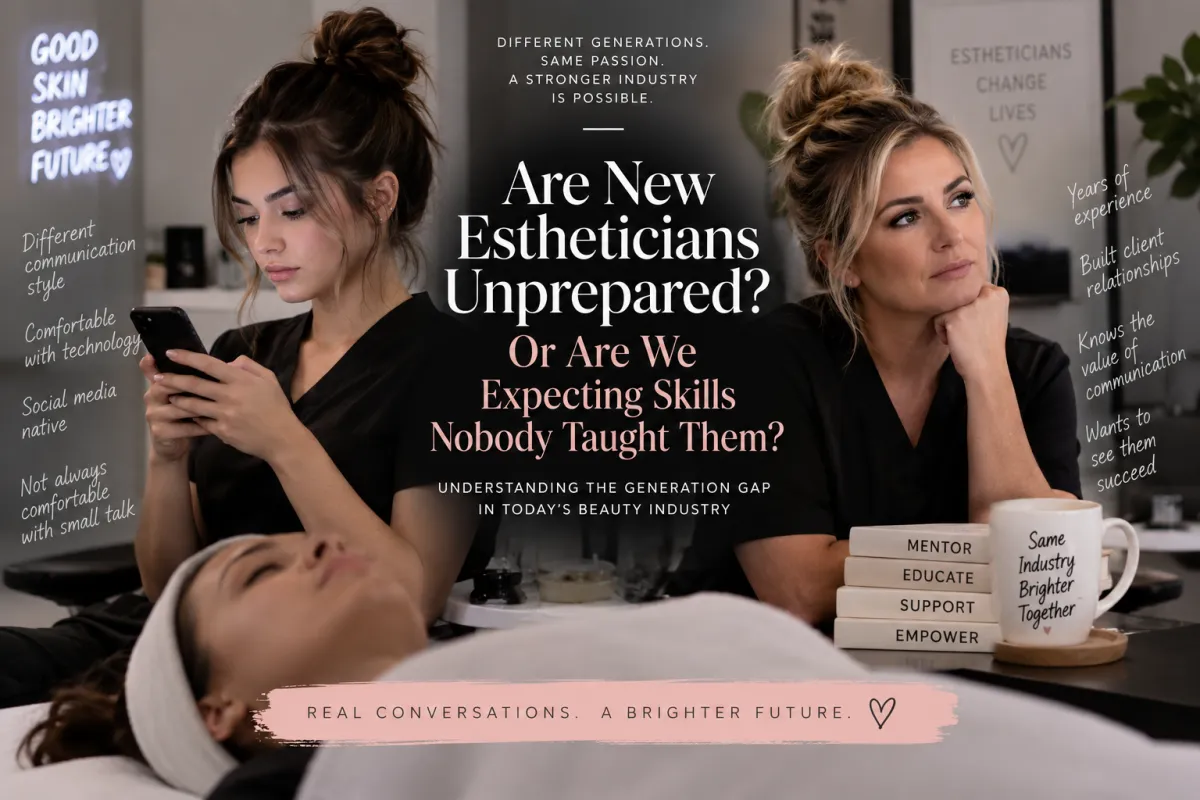
Unprepared or uneducated?
Are New Estheticians Unprepared - or Are We Expecting Skills Nobody Taught Them?
There seems to be a growing disconnect between experienced estheticians, employers, and the newest generation entering our industry. Maybe both sides need to understand what the other one is seeing.
I've been talking to estheticians who have been in this industry for twenty-plus years. Educators, employers, spa owners... People who have trained and hired multiple generations of estheticians. And lately, I'm hearing versions of the same conversation.
"Something is different with this generation"
Not necessarily their technical ability. Not necessarily their knowledge of skin. It's everything surrounding the treatment.
Communication
Initiative.
Confidence.
Client relationships.
Problem solving.
The willingness to be uncomfortable while they're learning.
One employer recently gave me an example I haven't been able to stop thinking about. A newer esthetician can have a brand-new client on her table for an entire service... and barely speak to her.
Think about that.
Someone has chosen your business. She's trusting you with her skin. You potentially have an hour with her, and there is no conversation. No relationship being built, no rapport, no learning about her lifestyle beyond the boxes on the consultation form. No natural conversation about what you're seeing in her skin. No planting the see for what you might work on together next time.
Then the service ends. The client leaves, and later, the esthetician wonders why she didn't rebook.
But before we call this generation lazy...
I think we need to ask a much better question: Did anybody actually teach them how to do this?
Because communication has changed dramatically. Many younger professionals grew up during a time when texting became conversation.
Friendships happen through phones. Appointments are booked online. Food appears without talking to anyone. Customer service happens through chat. Social interaction can be heavily digital. And then they graduate from esthetics school and enter one of the most intimately human businesses imaginable.
Now there's a stranger right in front of them saying, "Hi, I'm here for my facial." And suddenly we are expecting a completely different skill set.
Welcome her. Consult with her. Make her comfortable. Read her cues. Explain what you're doing without lecturing. Know when to talk and know when to shut up. Ask personal enough questions to understand her needs without becoming intrusive. Recommend products without sounding like you're selling. Discuss another service. Ask her to rebook.
And somehow make the whole thing feel completely natural.
That's a LOT of interpersonal skill.
Yet how much time do we actually spend teaching it?
Maybe we have confused personality with skill.
Someone can be introverted and still be exceptional with clients. Someone can be quiet and still build tremendous rapport. And a client certainly does not need sixty uninterrupted minutes of conversation while she's trying to relax.
Silence is not the problem.
Inability to build the relationship is.
There is a big difference between recognizing that your client wants to close her eyes and decompress, and being afraid to initiate a conversation at all. One is reading the room, the other may be a skill gap. And if that's the case, telling a new esthetician to "be more outgoing" is not particularly useful.
Maybe we need to actually teach what rapport looks like.
Employers, some of this belongs to us.
Experienced estheticians can fall into the trap of thinking certain things are obvious because we've been doing them for so long.
Of course you greet a client. Of course you ask how she heard about you. Of course you talk about her skin. Of course you tell her what you're doing. Of course you mention what you'd like to work on next. Of course you get her rebooked.
Except, apparently it isn't "of course".
If those behaviors are important to your business, make them part of training. Don't just teach your facial protocol. Teach the client experience protocol.
Role-play a consultation. Teach someone five questions that naturally start conversation. Show them how to transition from casual conversation into skin education. Let them hear how you recommend a product. Teach them what to say when a client doesn't want to talk. Teach them how you ask for the next appointment, and then let them practice until it stops feeling awkward.
That's mentorship.
It isn't lowering expectations, It's making expectations teachable.
But newer estheticians, there's another side to this.
Eventually, somebody has to say this too:
Being uncomfortable does not mean you should not have to do it.
I've also heard owners describe newer employees becoming overwhelmed and handing opportunities back to the owner.
A client needs a service they're nervous about performing? "Can you take her?"
A difficult conversation comes up? "Can you take her?"
Marketing feels uncomfortable? Avoid it.
Talking on camera feels weird? Don't do it.
Recommending home care feels salesy? Skip it.
But if your goal is to build clientele, eventually there aren't many people left to hand those things to. You HAVE TO become the esthetician who can handle them. And you don't become confident first and then start doing uncomfortable things.
It's quite the opposite.
Do the uncomfortable thing badly. Then again. And again. Then slightly less badly, then eventually you realize, "Oh. I actually know how to do this now."
Your client is already on your table.
This is the part that I wish more new estheticians understood. Getting someone through the door is HARD.
Marketing costs money. Content takes time. Advertising takes money. Referrals take time to build. And the somehow, against all odds, there is an actual human being lying on your treatment table.
You already did the hardest part. You got the opportunity or someone provided that opportunity. That hour isn't just an opportunity to perform a facial. It's an opportunity to create a relationship and learn why she's really there.
What bothers her skin? What has she tried? What does she have coming up? What would make her feel like this appointment was worth coming back for?
Not because you need to talk nonstop, and certainly not because every conversation should become a sales pitch. Don't do that. But becasue client retention is relational. People return to businesses where they feel remembered, understood, and cared for.
Technical skills get you part of the way there, but human connection does a lot of the rest.
And maybe "work ethic" isn't quite the right conversation either.
This is where generations can talk completely past one another. An experienced owner may look at someone who does not volunteer extra hours, doesn't want to stay late, or strongly protects their personal time and think, "where's the drive?"
The younger employee may be thinking, "I did exactly what I was hired and scheduled to do. Why is that considered a problem?"
Those are two completely different expectations. Neither gets resolved by privately deciding the other person has a terrible attitude.
If building clientele requires activity outside the treatment room, say that. If social media participation is expected, define it.
If new employees are expected to promote themselves, attend events, follow up with clients, practice services during downtime or participate in continuing education, make those expectations clear before frustration builds.
And new estheticians should understand the distinction between, "My employer expects free labor from me", and "Building the career I say I want requires initiative from me."
Those are not the same thing.
We might not need lower expectations.
We might need clearer ones.
Maybe employers need to stop assuming new estheticians arrive knowing interpersonal and business skills that were never formally taught. Maybe schools need to devote more attention to what happens after someone passes boards (hello, SkintelX!). Maybe experienced estheticians need to recognize that discomfort is going to be part of becoming good at this.
Your license says you're legally qualified to perform services. It does not mean you're finished learning how to be an esthetician. That part happens in the treatment room with awkward consultations, clients who challenge you, services that make you nervous, recommendations that don't come out quite right, videos you hate recording, conversations you don't know how to start, and hundreds of small interactions that eventually become experience.
Maybe neither generation is the problem.
Maybe we're watching two generations enter the same workplace with completely different definitions of communication, work, boundaries, initiative, and professionalism... and expecting the other one to already understand ours.
Employers can't mentor people they only criticize, but employees can't build confidence by continually avoiding the situations that require it. There has to be some movement from both sides.
Because this industry needs experienced professionals willing to teach, and it needs newer professionals willing to be taught.
So I want to hear from both sides.
Owners and seasoned estheticians: What skill do you wish new estheticians were better prepared for when they enter the workforce?
New estheticians: What do you wish an employer, educator or mento had actually taught you instead of assuming you already knew.
I have a feeling the answers might explain a lot.

Company
Home
About Us
Insights
Contact Us
Follow Us


